The price you see on an antivirus product page is rarely the price you will pay for long. A common pattern across major consumer brands is a steep first-year discount followed by automatic renewal at a much higher standard rate. Families that treat the promotional number as the real cost often discover the difference only when the credit-card statement arrives.
This is not a secret or a rare exception. It is the dominant pricing model for paid consumer antivirus and internet-security suites in 2026. Understanding how it works removes most of the surprise and lets you decide whether to stay, switch, or cancel on purpose.
How the Pricing Model Actually Works
Vendors advertise a discounted rate for new customers—often 50 to 75 percent off the “regular” price. The checkout page and marketing materials emphasize the low introductory figure. Auto-renewal is usually enabled by default. At the end of the promotional term the subscription renews automatically at the higher standard rate unless the customer cancels or changes the plan beforehand.
The higher figure is generally the list price the company has set for continuing customers. From the vendor’s perspective the first-year discount is a customer-acquisition cost. The renewal rate is closer to the ongoing price the business expects to receive.

Examples from recent public pricing (subject to change by campaign and region) illustrate the gap:
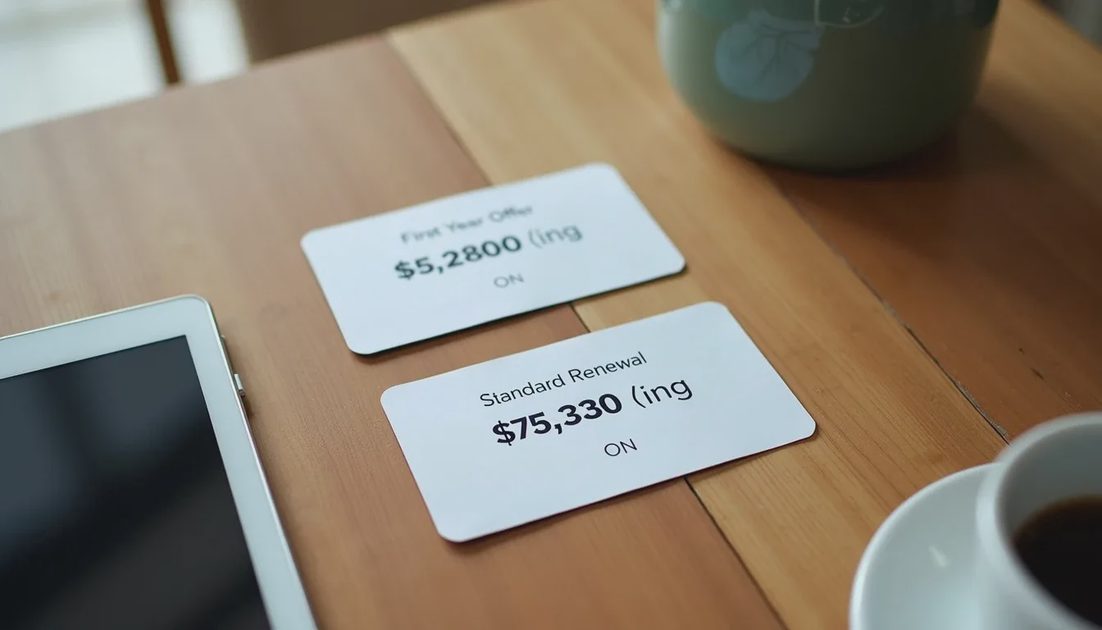
A suite offered at roughly $30–$50 for the first year commonly renews in the $90–$150 range.
Some products show increases of 100 to 200 percent or more between the promotional term and the first renewal.
Multi-year prepaid deals sometimes reduce the average annual cost, but the same pattern often reappears when that longer term ends.
The exact numbers shift with promotions, device counts, and geography. The structure itself is consistent: low entry price, higher continuation price, auto-renewal as the default path.
Why Families Miss It
Several design choices make the gap easy to overlook.
The large promotional number is the most visible element on the product page and in ads. The renewal rate appears in smaller text, often near the bottom of the checkout flow or in the terms. Many people complete the purchase focused on the discounted figure and the feature list.
Confirmation emails and account dashboards may mention the renewal date without restating the higher price in equally prominent language. When the charge eventually posts, it can feel like an unexpected increase even though the terms were disclosed.
Cancellation itself sometimes requires logging into an account portal, navigating menus, or contacting support. The friction is rarely absolute, but it is enough that busy households postpone the decision until after the renewal has already occurred.
None of this is unique to antivirus. Subscription software, streaming services, and many other digital products use similar models. Antivirus simply combines the pattern with a product that many people set and then forget.
What the Renewal Price Represents
The higher renewal rate is not automatically unfair. Maintaining detection engines, cloud infrastructure, customer support, and regular updates has real costs. A company that acquires customers at a steep discount needs a sustainable continuing price.
The practical issue for families is transparency and decision timing. A product that costs $40 the first year and $120 the second is a different financial commitment from one that costs $70 both years. Evaluating only the first number produces a distorted comparison.
Some users mitigate the gap by canceling near the end of the promotional term and repurchasing at the current new-customer rate if an equivalent offer is still available. This works only when the offer remains open and the user remembers to act. It is a workaround, not a design feature.
Practical Steps That Remove the Surprise
Record the real numbers at purchase. Note the promotional price, the disclosed renewal price, the exact renewal date, and the number of devices covered. Keep the confirmation email.
Set a calendar reminder. Place it two to four weeks before the renewal date. The reminder should prompt a deliberate choice: renew at the higher rate, switch products, or cancel.
Compare total cost, not first-year cost. When evaluating alternatives, calculate the approximate two-year or three-year expense under realistic renewal assumptions. A higher first-year price that stays stable can be cheaper over time than a deep discount that triples later.
Understand cancellation mechanics before you need them. Log into the account portal once after purchase and locate the cancellation or auto-renew toggle. Knowing the steps in advance removes friction later.
Watch for early-renewal offers. Some vendors send discounted renewal prompts before the term ends. These can be useful if you plan to stay; they are still higher than the original promotional rate in most cases.
Treat built-in protection as a baseline. Microsoft Defender and the equivalent tools on other platforms have improved enough that some careful households can rely on them plus strong habits. That option has no renewal surprise. It also lacks many of the extra features paid suites provide.
A Clear-Eyed View of the Tradeoff
The renewal-pricing model is widespread because it works for the companies that use it. Customers who remain on auto-renew after the promotional period generate higher lifetime revenue. Customers who notice and act have options: accept the higher rate, switch, or cancel.
For families the useful response is neither outrage nor resignation. It is simple process. Know the two prices at the moment of purchase. Put the renewal date on a calendar. Decide on purpose rather than by default. That small amount of attention converts a common pricing structure from a recurring source of frustration into an ordinary household decision.
Security software is only useful if it stays installed and paid for on terms the household understands. Looking past the first-year number is one of the highest-leverage habits a family can adopt when choosing and keeping protection.